
Wildfire Risk, Insurance, and Oakmont’s Financial Future
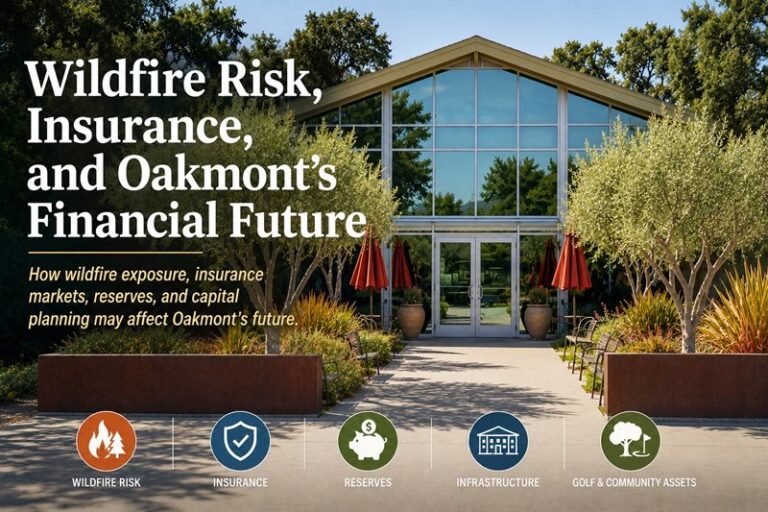
As Oakmont members consider major financial decisions involving reserves, infrastructure investments, insurance costs, the proposed Berger Center project, and even the potential purchase of an aging OVA office building, there is another issue quietly influencing all of them: wildfire risk.
Wildfire risk is often discussed as a homeowner insurance issue. In reality, it is also a community financial planning issue. The same reserve funds, borrowing capacity, dues revenue, and capital resources needed to maintain Oakmont’s facilities may also be needed to respond to future disasters, absorb insurance deductibles, address uninsured losses, or recover from major wildfire events.
This matters because Oakmont’s reserve studies already identify substantial future obligations involving pools, HVAC systems, roofs, irrigation infrastructure, building systems, recreation facilities, and other community assets. At the same time, OVA is evaluating significant capital investments, including the Berger Center expansion and modernization project, discussions regarding purchasing an OVA office building, remodeling the Central Pool complex and new obligations regarding the golf course properties. These decisions do not occur in isolation. They all draw from the same pool of financial resources.
THREE LAYERS OF WILDFIRE RISK
Oakmont’s wildfire exposure exists on three interconnected levels.
The first is the individual homeowner. Throughout Sonoma County, homeowners face increasing challenges obtaining and maintaining affordable insurance coverage. Deductibles are rising, policy terms are changing, and many residents have experienced non-renewals or movement into the California FAIR Plan and surplus-lines markets.
The second layer involves Oakmont’s many sub-associations. These communities operate under their own CC&Rs, budgets, reserve funds, and insurance programs. Like homeowners and OVA itself, they face increasing insurance costs, new water conservation rules and requirements, changing coverage terms, larger deductibles, wildfire exposure, and the challenge of maintaining adequate reserves. Together they represent another layer of financial exposure within the broader Oakmont community.
The third layer involves Oakmont Village Association itself. OVA owns and maintains a substantial collection of community facilities and infrastructure, including the Berger Center, Central Activities Complex, East Rec, West Rec, swimming pools, maintenance facilities, landscaping systems, irrigation systems, and numerous other common assets that support community life. In addition, OVA has significant financial interests associated with the golf course properties and related operations. While the golf courses themselves are owned through a separate corporate structure, wildfire risk affecting golf-related facilities, infrastructure, operations, or financial performance could have implications for the broader Oakmont financial system. Together, these assets represent a large and interconnected network of facilities, infrastructure, and financial obligations exposed to the same regional wildfire environment.
All three layers are exposed to the same regional wildfire environment.
NEW FIRE HAZARD MAPS AFFECT OAKMONT
An additional factor is California’s updated wildfire hazard mapping. Significant portions of Oakmont now fall within areas designated as Wildland-Urban Interface (WUI), High Fire Hazard Severity Zones, or Very High Fire Hazard Severity Zones.
These designations affect not only individual homes but also many of Oakmont’s shared facilities and amenities. Berger Center, East Rec, West Rec, swimming pools, common landscaping, irrigation infrastructure, golf-related facilities, and other community assets exist within the same broader wildfire environment that influences insurance availability, underwriting decisions, deductibles, construction costs, and long-term risk assessments.
As state fire maps evolve and insurers increasingly rely on sophisticated wildfire modeling, these designations may continue to influence both homeowner and association insurance costs as well as future planning decisions.
A CHANGING INSURANCE MARKET
Recent OVA insurance renewal materials describe a California insurance marketplace that has become increasingly challenging for homeowners associations and large property owners.
Traditional carriers have reduced exposure in wildfire-prone regions. More policies now involve combinations of admitted and non-admitted insurers, surplus-lines carriers, larger deductibles, and more restrictive underwriting requirements.
The issue is no longer simply whether insurance can be purchased. The more important question may be how much risk remains after insurance is purchased.
Insurance policies increasingly contain deductibles, exclusions, limitations, sublimits, and coverage conditions that can leave policyholders responsible for significant costs following a major event. Recent OVA insurance materials show that East Rec and West Rec carry substantial wildfire and wildfire-smoke deductibles under the Association’s property coverage. While insurance remains a critical part of risk management, these provisions illustrate how some financial responsibility may still remain with OVA following a major catastrophe.
WHY RESERVES MATTER
This is where reserve funds become part of the wildfire conversation.
Most people think of reserve funds as money set aside for predictable future replacements such as roofs, HVAC systems, pools, asphalt, irrigation systems, and building components. Reserve studies are designed around these expected replacement cycles.
However, reserve strength also affects an organization’s ability to absorb unexpected financial shocks.
If a major wildfire were to damage community facilities, OVA could face major deductibles, emergency operating expenses, reconstruction overruns, temporary facility closures, debris removal costs, and expenses associated with items that may not be fully covered by insurance.
Reserve funds are not insurance. But reserve strength can significantly influence how quickly and effectively an organization recovers from a disaster.
THE CONNECTION TO LONG-TERM PLANNING
Wildfire risk also intersects with larger financial decisions.
Reserve studies already identify substantial future spending needs across Oakmont’s amenity system. Pools, HVAC systems, roofs, building components, irrigation systems, accessibility improvements, and other major capital needs will require significant resources over the coming years.
At the same time, OVA continues to evaluate the $8 million Berger Center expansion and modernization project, future facility improvements, and potential office building decisions. Whether these projects are funded through reserves, borrowing, or a combination of both, they ultimately affect the same financial flexibility that could be needed following a future disaster.
These issues are not independent of one another.
The greater an organization’s financial flexibility, reserve strength, and borrowing capacity, the more options it has when unexpected events occur. Conversely, the more resources committed to long-term obligations, debt service, or major capital projects, the less flexibility may be available during a crisis.
LOOKING AT THE ENTIRE PICTURE
One of the most important observations from reviewing recent insurance materials is that wildfire risk is often discussed in separate pieces. Homeowners focus on homeowners’ insurance. OVA focuses on common facilities and infrastructure. Sub-associations focus on their own policies and reserves.
In reality, all three levels are interconnected.
A major wildfire event would not distinguish between private homes, sub-association property, OVA facilities, or golf-related assets. All would be affected by the same insurance market, the same construction inflation, the same labor shortages, and the same rebuilding challenges.
The cumulative financial impact across the entire community may ultimately be more important than any single insurance policy or facility.
A COMMUNITY CONVERSATION
Oakmont has demonstrated resilience through some of Sonoma County’s most destructive wildfire events. However, the expansion of High and Very High Fire Hazard Severity Zone designations affecting portions of Oakmont reinforces that wildfire exposure is no longer a theoretical concern.
As insurance markets continue to evolve, the conversation may need to expand beyond premiums and coverage limits. The larger questions involve reserve strength, financial flexibility, infrastructure priorities, capital planning, and community resilience.
Wildfire preparedness is no longer simply a matter of vegetation management and evacuation routes. It has become a financial planning issue as well.
For homeowners, sub-associations, and OVA alike, the challenge is increasingly the same: balancing insurance costs, reserve funding, maintenance obligations, and future capital needs while remaining financially resilient in an era of growing wildfire risk.
Understanding that broader picture may help Oakmont better prepare for whatever challenges lie ahead.
SOURCES
OVA Board Packet – May 19, 2026 (2026/2027 Insurance Renewal Proposal)
https://oakmontvillage.com/article/5-19-2026-board-agenda-resolution-packet/
OVA Board Packet – December 16, 2025 (2026 Insurance Renewals)
https://oakmontvillage.com/article/12-16-2025-board-agenda-resolution-packet/
OVA Board Packet – December 17, 2024 (2025 Insurance Renewals)
https://oakmontvillage.com/article/12-17-2024-board-agenda-resolution-packet/
Oakmont Village Association Reserve Studies
https://oakmontvillage.com/docs/
California Office of the State Fire Marshal – Fire Hazard Severity Zone Maps
https://osfm.fire.ca.gov/what-we-do/community-wildfire-preparedness-and-mitigation/fire-hazard-severity-zones
City of Santa Rosa https://www.srcity.org/596/Wildland-Urban-Interface
California Department of Insurance
https://www.insurance.ca.gov
California FAIR Plan
https://www.cfpnet.com
Sonoma County Fire District
https://sonomacountyfd.org

