
OGC Water Drainage Argument Explored

The Oakmont golf courses were built over a period of years between 1963 and 1980, with the first nine holes of the West Course opening in 1964.
Representatives of the Oakmont Golf Club (OGC), in Oakmont News articles and repeatedly at their presentations to the community in town halls, have claimed that the drainage, creeks and ponds on the golf course perform a service to the community for which OGC should be reimbursed by OVA. Critics of the proposal see this OGC claim as specious in that the flow of water to, and storage on, the courses are not design flaws for which OVA should compensate OGC. They are actually golf course design features.
The land on which Oakmont and the golf courses sit was previously pasture and small farms with some marshy areas and scattered orchards. It was criss-crossed by multiple creeks that flow to the two main creeks draining both the hills in present Trione-Annadel State Park on one side and the Hood Mountain/Sugarloaf Ridge range on the other side. Sonoma Creek runs south to San Pablo Bay and Santa Rosa Creek flows to the Russian River and the Pacific Ocean.
The main creek through the center of Oakmont, now called Oakmont Creek, is the easternmost portion of Santa Rosa Creek and was labeled as such on old maps. It is fed by multiple smaller creeks flowing from the surrounding highlands, including Charlotte and Wild Oak Creeks.
These existing creeks and marshes were utilized in designing the golf courses, both as visual water features (or in golf terms “water hazards,” as there is a scoring penalty if your ball enters them) and as storage ponds for irrigation of the courses.
During course construction, grading of existing topographical features is performed to enhance drainage and water flow. Storm water management controls are also incorporated into the design of the golf course as ponds and grass swales, which can be utilized to control runoff from adjacent development. All of this shaping and drainage can have the added advantage of capturing water for irrigation of the course.
In his book The Anatomy of a Golf Course, architect Tom Doak writes: “The golf architect must often create ponds and other drainage retention structures…to collect runoff during a storm. Where a natural low spot occurs, or where one is created in the design, subsurface drainage via catch basins and drain tile is relied upon to carry excess runoff to a nearby outlet such as an existing storage pond, a dry well, or a retention basin.”
Such swales and collection areas were designed into the Oakmont golf courses and subsurface perforated pipes drain the soil-filtered water into the creeks and ponds.
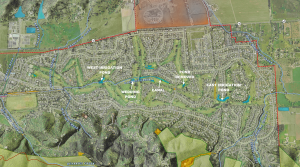
As seen in this photo, the ponds throughout the golf courses follow the path of Oakmont Creek. The main irrigation pond for the East Course near the East Clubhouse is on the right side. Following the creek to the west we see the canal bordering the West Course 17th hole leading eventually to the Wedding Pond near the West 18th tee and then to the main irrigation pond for the West Course near the West 2nd tee.
All of these water features were designed to collect rainwater directly and from local runoff. However, captured and stored rainwater is not sufficient to irrigate the courses through the dry months. This was addressed in the original design with the use of recycled wastewater (provided free of charge) from the Oakmont treatment plant near Channel Drive built by Oakmont developer H.N Berger. In later years three wells were drilled to provide additional water. The water from rain, wells and treated wastewater was stored in the various irrigation ponds around the courses. Gravity and a series of pumps move the water to the various ponds as needed.
According to James Barrett in his book Golf Course Irrigation, 18 hole regulation golf courses require anywhere from 300,000 to 700,000 gallons of water per day in peak season. The two Oakmont golf courses have benefited over the years from the abundance of water in runoff from the surrounding highlands and the Oakmont community, the well water beneath it and the free water provided for over 50 years by the wastewater treatment plant. It was also designed with ample storage capacity in multiple irrigation and ancillary ponds.
Algae and other forms of pond scum and plant infiltrations tend to grow in golf course ponds. It is largely caused when the fertilizer used on the course runs off into the ponds during normal course watering, increasing the nutrients in the ponds. OGC claims that clearing the ponds of such growths and infiltrations should be a shared expense with the surrounding Oakmont community. Yet this is a maintenance issue for all golf courses that employ water features in their design and is not unique to Oakmont.
In 2012 the City of Santa Rosa and its ratepayers contributed $2.8 million to the OGC in an agreement to settle the closing of the Oakmont wastewater treatment plant. According to a 2/27/12 article in the Press Democrat, “the club will spend the money revamping its irrigation system, including installing more efficient sprinklers, removing 32 acres of thirsty turf and building a 2.5-acre lake in the middle of a driving range, complete with floating golf balls.” A large portion of this money would have been needed to construct the new lake, creating even more water storage, but the plans were later canceled.
Now OGC is claiming that the surrounding community has “received a free ride” and that OVA should share the costs of maintenance of ponds and creeks, the very design features that have contributed to OGC’s viability over the years.


Excellent article, and we should all welcome your research explaining the water infrastructure within the golf courses and its history. This type of knowledge must be the foundation for any intelligent decision about sharing the costs of maintenance of this infrastructure, rather than the largely unfounded claims made by Rick Warfel in his propaganda pieces in the Oakmont News.
Brilliant investigation. Facts must be faced by OGC and those who think Oakmont residents should pay for the club’s years of near-insolvency. Where did that gift of $2.8 million from Santa Rosa taxpayers go, since the work that was to be done was apparently not completed? If the OVA provides money to OGC to keep the courses open, isn’t the same thing likely to happen? The OGC cannot seem to run an ongoing profitable, sustainable business, despite the cash from the city and the outstanding loans the owners there have. “The definition of insanity is doing the same thing over and over again, but expecting different results”.
Michael Connolly wrote a seminal account of the origin of the Oakmont golf courses and their technical design features. It is a must read for all those concerned with the current controversies surrounding the requested subsidy – styled as fee for services – in the amount of $1.4mm (over 5 years) by the OGC of the OVA membership.
Thank you for taking the time to research the OGC water issues and communicate facts to our Oakmont residents.
I question an Oakmont News reporter why my concerns of Warfel’s demand voiced at the 6/5 meeting were omitted from the newspaper.
Apparently my “comments were not heard” was the reply I received. Since there is a video to review for any missed comments, I felt it was yet another biased article in supporting the failing golf course.
Good that we can now have a full understanding of the ponds, their lack of past maintenance and question what happened to the $2.8Million given to the Oakmont Golf Course???
As far as the $2.8 million contribution from the city, OGC canceled the driving range lake project but did use the funds for the other items mentioned, i.e. “revamping its irrigation system, including installing more efficient sprinklers (and) removing 32 acres of thirsty turf…”
Excellent article — very much appreciated.
A side point but still enlightening: Warfel’s misrepresentative claims for OGC are particularly galling since his actual actions indicate that he knows these matters are OGC’s (not OVA’s) responsibility.
Soon after moving to Oakmont on Valley Lakes Drive, Warfel arranged for OGC to pay to have the “water feature” behind his own house cleaned up. Per Warfel, he and some of his adjacent golf-course-home neighbors on that section of Valley Lakes Drive also contributed to the cost. There was no mention or propaganda then of any of this being an OVA responsibility or OVA “free ride”.
Brilliant, Michael. This is serious journalism at its best. Thank you.
Thank you for the research and thorough explanation of the design and history of the water situation on the golf course/s. Very informative and appreciated.
Excellent job of reporting Michael. May I add a couple of additional points? You have answered the question of what happened to the money given to OGC as a settlement for the closing of the water treatment plant but it should be noted that the central storage water storage area scheduled for the driving range and its floating golf balls was cancelled because a study done by hydrologist engineers indicated that the subsurface characteristics were entirely unsuitable for that purpose. The bulk of the money went, as you have reported, into a high tech computer-controlled water irrigation system which replaced an aging and inefficient facility. The drilling of another well helped to replace the missing treated water and this, of course cost a lot of money too.
Julie, you raised the question of where did the settlement money go? I hope that question has been answered to your satisfaction. You do go on to state that “The OGC cannot seem to run an ongoing profitable, sustainable business, despite the cash from the city and the outstanding loans the owners there have.” As has been repeatedly noted in Nextdoor the difficulties faced by the OGC (and many other golf courses around the U.S.) have been many and have included several serious recessions which resulted in the altered retirement plans of many “Baby Boomers” In addition, in Sonoma county challenging weather conditions of the past few years and last year’s wild-fires ate deeply in the cash reserves of the Club, as did the lost income which accompanied the installation of the irrigation system. The fact that a number of golf courses around the country, and a few more recent ones in Sonoma, Marin, and Napa counties have closed, suggests that there is something greater than mismanagement to blame.
Finally, the “water feature” that Gerry refers to is a major component in the OGC system which had become almost completely filled with silt flowing into it from the surrounding residential areas, etc. It was also filling up with vegetation, further compromising its important role and posing an eye-sore view for the neighbors. Clearing out the clogging material was expensive but the neighbors helped out. Bravo to them.
“The fact that a number of golf courses around the country, and a few more recent ones in Sonoma, Marin, and Napa counties have closed, suggests that there is something greater than mismanagement to blame.”
I couldn’t agree more, John. That reality is one solid reason why the OVA should reject entering into any financial agreement with OGC for longer than a single year. We need to better understand what is going on and consider all long-term possibilities before making a substantial commitment of member dues. Our own forthcoming cash-flow shortfall in the next 2-3 years adds weight to this common sense view.
I look forward to your update on the golf club.
Thank you, Michael and John, for your research into this important manner. It’s nice to see a discussion based on facts.
Excellent article! I suspected that the OGC’s claims about their drainage issues were exaggerated. How can we come to terms with a company who is not forthcoming with us? How can we support the OGC with no benefit to us, other than prolonging their demise? If we are to give them financial help, we need skin in the game, period.