
‘Member/People Power’ vs. ‘Board Power’
In a recent Nextdoor post, Malka Osserman applied a quote from Noam Chomsky to her critique of User Groups:
“The smart way to keep people passive and obedient is to strictly limit the spectrum of acceptable opinion, but allow very lively debate within that spectrum. That gives people the sense that there’s free thinking going on, while all the time the presuppositions of the system are being reinforced by the limits put on the range of the debate.” ~ Noam Chomsky
Applying Chomsky’s observation to the design for the “Oakmont 2030 Roadmap” as it fits into the Board’s policy for project management and decision-making is also interesting.
In the 2030 model as it was designed to fit directly into the Board’s policy, there was an enormous amount of intentional blue sky brainstorming activity — positive, productive community conversations — produced by a substantial number of Oakmonters. But the entirety of community involvement fits only into Board policy Phase 2 – “Generate Possibilities.”
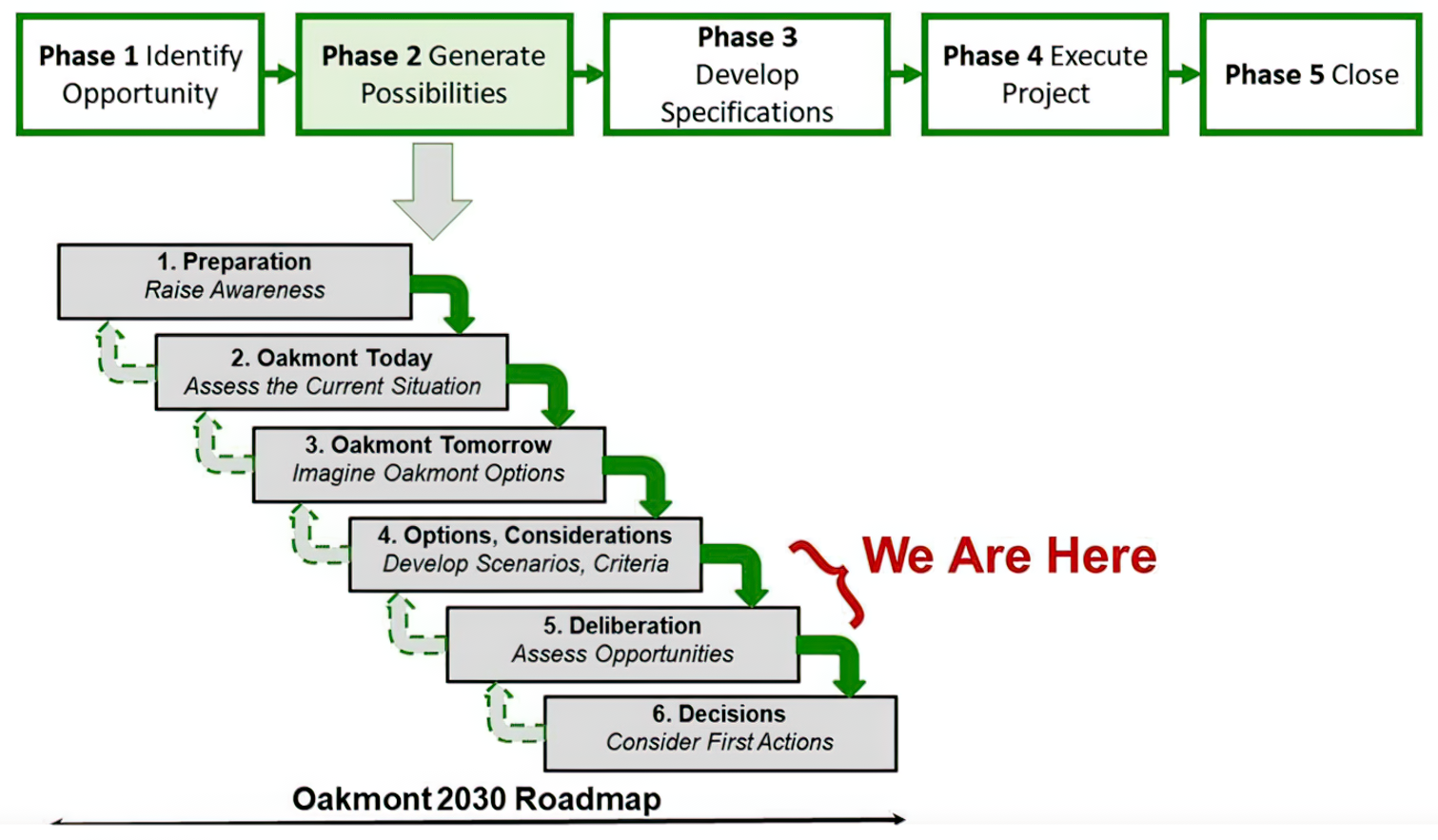
All other phases of the decision-making policy, including Phase 1 (Identify Opportunity), Phase 3 (Develop Specifications), Phase 4 (Execute Project), and Phase 5 (Close) are the Board’s exclusive prerogatives. Of course, within its prerogatives the Board could choose to survey (but doesn’t) and could choose to have binding referenda (but doesn’t unless a necessitated dues increase mandates a vote by statute).
That’s why candidates’ attitudes toward “Member/People Power” vs. “Board Power” matter in this election – and why the Bylaws must be amended to mandate a binding membership vote at a specified level of capital improvement.


What was “the main foundation, the primary goal” of generating ideas via Oakmont 2030? Spoiler Alert: no surprise.
Tom Kendrick, December 12, 2022 Town Hall
https://oakmontvillage.com/article/12-12-2022-2030-town-hall/
Beginning at 19:00 to 21:30:
“You look at the name 2030, well it’s not really focused on the short term. So the fact that we got so many good ideas that relate to really near end possibilities is kind of a bonus. So thank you to everybody that participated, everybody who participated in conversations, the working groups, and so forth.
“What we also wanted to do was to pull apart the long term ideas, and that’s about a third. Huge number still. A good number of those were good ideas that don’t require much in the way of investment and of course those are ideas that have a lot of appeal because we don’t spend a lot of money and we could probably do those without a whole lot of angst.
“The longer term ideas that will require funding – David alluded to that just a moment ago, David Dearden has been on several committees over the years looking at these questions. There are about 40 ideas there and those ideas really are sort of the main foundation, the primary goal we got into this to really look at.
“Not all of those ideas will go anywhere, perhaps none of them, but we want to take a look, a hard look, at what could we do as a community to advance on some of the ideas that came up there.”