
Berger Center Is Only One Piece of a Much Larger Financial Puzzle
A Town Hall About More Than Berger
The June 8 Berger Center Assessment Project Town Hall was presented as an update on proposed improvements to one of Oakmont’s most important community facilities. By the end of the afternoon, however, the discussion had expanded well beyond Berger Center itself.
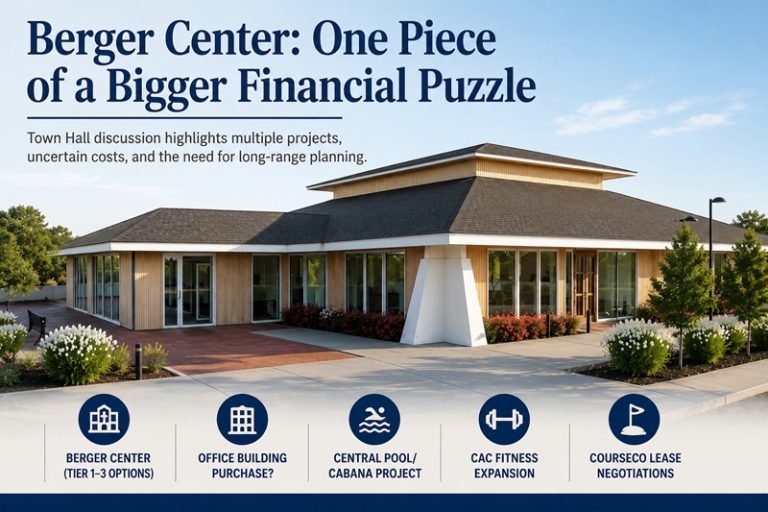
Residents heard updates not only about Berger Center, but also about a possible purchase of the building currently housing our OVA administrative offices, ongoing negotiations involving golf-course operations and lease, planning for Central Activities Center improvements including the pool and cabana, and future possibilities for expansion of the fitness center. Collectively, these discussions pointed to a broader challenge facing Oakmont: how to prioritize and finance multiple major projects within a limited pool of financial resources.
Berger Center: Important Decisions Still Ahead
One of the most significant clarifications came from Board President Steve Spanier, who emphasized that no final project scope has yet been selected.
“We have not selected a scope. We haven’t selected whether we’re going to be doing Tier One or Tier Two or Tier Three yet.”
That distinction is important because the three ESG tiers represent very different levels of investment. Tier One focuses primarily on infrastructure and code-related needs. Tier Two adds modernization and reserve-related improvements. Tier Three includes facility expansion and enhancements estimated at approximately $8 million.
But residents have not seen a detailed side-by-side comparison of Tier Two and Tier Three in order to clearly understand which components are essential, which could be phased, and which represent optional improvements.
Contract Negotiations Remain Active
The Town Hall also revealed that negotiations with ESG are still underway. Spanier reported that both Board members and legal counsel identified provisions within the proposed contract that require revision.
“The board has found some aspects of the proposal that are unacceptable. The legal team has found some aspects of that contract that’s unacceptable.”
He later added, “We don’t want to spend money we don’t feel like we have to spend,” and “We don’t want to agree to terms that we feel that we don’t have to agree to.”
Those comments suggest that project scope, contract language, and financial commitments remain active areas of review.
The Office Building Discussion
Perhaps the most interesting additional topic involved a possible purchase of the building currently housing OVA administrative offices.
According to Spanier, OVA has begun reviewing owner financial information, tenant occupancy, building systems, equipment condition, repair obligations, and market factors. He also noted that Oakmont currently pays approximately $90,000 annually in rent and that Umpqua Bank is expected to vacate space in the building later this year.
Another unanswered question involves how a potential office building purchase would be financed. Depending on the property’s value and financial performance, commercial lenders sometimes structure loans that are secured primarily by the building itself. Whether such an approach would be available to OVA remains unknown, but the issue illustrates the importance of examining a range of financing alternatives before major borrowing decisions are made. Understanding those options may become increasingly important as Oakmont evaluates multiple capital projects competing for limited financial resources.
The over arching discussion raises important questions regarding financing, long-term ownership costs, and how a potential acquisition might affect Oakmont’s flexibility to pursue other projects.
Golf, Pools and Other Capital Needs
The Town Hall also touched on negotiations with CourseCo regarding possible changes to the golf-course operating agreement. Golf remains an important part of Oakmont’s financial picture because members continue to support operations through subsidies and a large capital expenditure this year.
At the same time, planning continues for Central Activities Center improvements. Previous discussions have referenced pool and cabana related costs ranging from approximately $700,000 to $800,000 for renovation of the existing facility and approximately $2.8 million for more extensive replacement or relocation concepts.
Viewed individually, each project may be reasonable. Viewed collectively, they illustrate the growing number of competing demands facing the community.
Future CAC Expansion Possibilities
Vice President Jeff Neuman discussed how a future office-building acquisition could influence planning for the Central Activities Center.
“Maybe we can expand the fitness center at fairly low cost.”
His comments suggest that decisions regarding office space could create opportunities to reconfigure existing facilities and respond to growing demand for recreation and fitness programs.
The June Vote and Remaining Questions
One Resident asked whether the Board intended to vote on Berger Center at its June meeting. Spanier confirmed the item was on the agenda but stressed that no immediate approval was required.
“The item is on the June 16 open board meeting agenda for a vote. However, there’s no requirement that we actually approve it or disapprove it that day.”
He also stated, “I would like to see those complications resolved to the greatest extent that we can before we make a decision.”
When asked whether the Board had already discussed what action it intended to take, Spanier responded, “The board has not had any internal discussions about that,” explaining that deliberations must occur publicly.
The Need for a Comprehensive Roadmap
The strongest theme emerging from the Town Hall may have been the need to evaluate projects as part of a larger system rather than in isolation.
At various points, residents heard about Berger Center improvements, a possible office-building acquisition, golf-course negotiations, pool and cabana projects, fitness-center expansion possibilities, reserve obligations, and long-term financing considerations.
Spanier summarized the challenge by stating, “We can get at least a good estimate of costs for all these projects and figure out if and how we can afford to do them.” He later added that, “The board will factor all those questions and considerations into our ultimate decision.”
Those remarks raise a question some residents continue to ask: should Oakmont publish a comprehensive financial and facilities roadmap showing how these projects fit together, how they may affect reserves and borrowing capacity, and what tradeoffs may become necessary if multiple projects advance simultaneously?
The larger issue may be how Oakmont chooses to allocate its financial resources across an increasingly complex list of community needs—and whether residents have sufficient information to evaluate those choices before major commitments are made.
AI Disclosure: tools were used to assist in searching and organizing Town Hall transcript quotations.
Sources and Reference Documents
oakmontvillage.com/article/6-15-26-town-hall-berger-assessment-project
oakmontvillage.com/article/6-8-2026-board-agenda-berger-center-planning-town-hall
oakmontvillage.com/article/5-19-2026-board-agenda-resolution-packet
oakmontvillage.com/berger-assessment
oakmontvillage.com/article/annual-budget-report-2026
oakmontvillage.com/article/2026-03-monthly-financial-report
oakmontobserver.com/oakmont-at-a-crossroads-berger-center-expansion


Am I only one that read the article in ON where date of June 15 was given for discussion on Berger issues?
The board changed the date.
… and OO corrected the error within an hour of the article going live.