
A Novel Approach to Newspaper Publishing in an Era of “Free” Information
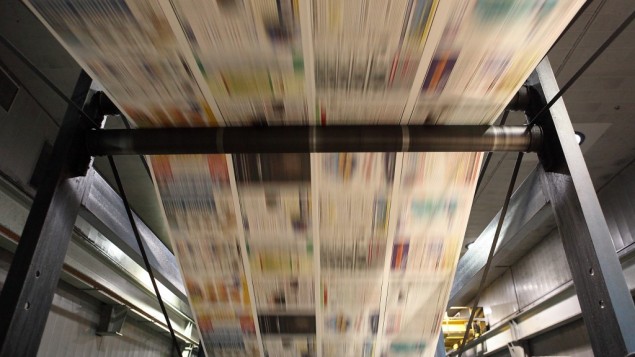
Many small (and large) newspapers are struggling as they compete with the overwhelming amount of content available for free on the internet. A local publisher in Sonoma County is employing a novel approach, one that has been successful for other small newspaper publishers.
“Last year Rollie Atkinson, the owner and publisher of The Healdsburg Tribune and three other weeklies in Sonoma County, was staring down a grim financial reality. The business model, he said, was ‘failing rapidly.’ He was tired of throwing his savings into the newspapers to keep them going, and weary of the ‘daily struggle’ of staying afloat in an environment where readers have access to a torrent of information for free.”
“Local newspapers have long been staples of communities across the country. But the shifts in the wider media industry have been devastating to these smaller publications. Over the past decade, many have closed while others have cut their newsroom staffs and how many times a week they publish.”
“Just to the south, in Berkeley, Calif., an online news site called Berkeleyside had taken a new approach to the crisis in local news: Sell stock to its readers. It was wildly successful. The site’s direct public offering — a more intimate version of an initial public offering in which a company sells stock without an investment bank — began in 2016 and closed this year. It raised $1 million.”
“So, in what is believed to be a first for a local newspaper, Mr. Atkinson undertook a similar strategy for the four newspapers that make up his Sonoma West company, which have a combined paid circulation of 9,900: The Healdsburg Tribune, The Cloverdale Reveille, The Windsor Times and Sonoma West Times & News. Since March, he has gotten a quarter of the way to his goal of $400,000. The offering lasts until March 2019, and the road show consists of Mr. Atkinson making his pitch over cocktails, at dinner parties and in everyday conversations around town.”
To read the full story in the New York Times, “Turning Newspaper Readers Into Investors” by Tim Arango, go here
And consider subscribing to local and national newspapers, as several are struggling to stay afloat. Many of the Founding Fathers were writers and publishers in their own right and thought enough of the “fourth estate” to enshrine its protection in the Constitution.


I read the New York Times article, but I come away with unanswered questions like:
Why would investors buy into local papers? “Investment” implies expectation of some return that is proportional to the number of shares purchased. Is this just a re-naming of donations? If not, how is it different from donations? Do the shares pay dividends (at least theoretically)? Can they be re-sold freely?
Don’t get me wrong, I am not arguing that local papers should not be supported. I just don’t understand this mechanism, and the NY Times article didn’t help.
For those of us who would be unlikely to read more than a couple of pages of a printed paper, I’d suggest that a paid digital subscription, where available, is a more environmentally-friendly way of supporting your favorite news outlet.
Bruce, there was a link to the prospectus in the article. Investors would be purchasing preferred shares of stock in the corporation at $4 per share, paying an annual dividend of 3%. It is definitely a risky investment but, as is usually the case, preferred shares carry less risk than common shares:
“In the event of any liquidation of the Company, or any sale of the Company through merger or sale of assets, holders of shares of Preferred Stock will be entitled to receive an amount equal to the original purchase price of such shares (as adjusted for any stock dividend, stock split,combination or other similar recapitalization with respect to the Preferred Stock) plus the amount of accrued but unpaid dividends thereon, prior to any payments being made to the holders of the Company’s common stock in respect of such holders’ shares of such common stock.”
I do agree with you that people should consider digital subscriptions (I have several) as opposed to printed/delivery subscriptions.