
2025 Candidates Night Summary
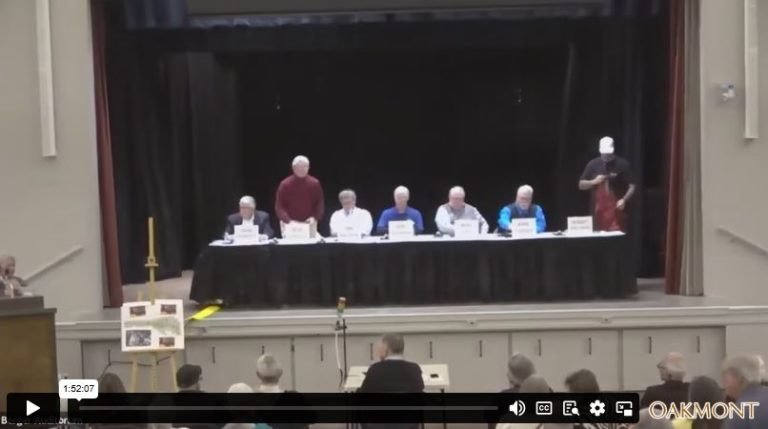
This year’s Candidates Night event took place from 6 pm until 8 pm on Wednesday, Feb 19. In addition to in-person attendance, members could view the event via Zoom. 56 questions were submitted, but only 9 were asked at this event, because of the relatively large number of candidates (7) and the lack of time for asking more.
The purpose of Candidates Night each year is to provide Oakmont voters with the information they need to make wise and informed choices when they vote for Oakmont Village Association (OVA) directors in March. To that end, there should be two goals: first, to identify issues of importance to the OVA membership and, second, to inform the OVA membership about how candidates for the OVA Board of Directors view these issues. With these goals in mind, the questions asked were carefully selected and/or condensed by a group that included the Board president (Heidi Klyn), OVA staff, and three OVA members not associated with the Board.
In general, I will not note assertions by any candidate that I consider to be “motherhood and apple pie”, e.g.
- I promise to carefully listen to community members and to take into account their opinions while serving on the Board
- I believe strongly in fiscal prudence and keeping Oakmont affordable.
- I promise maximum transparency allowed by law.
- etc etc etc
Every candidate will say similar things in this regard, so repeating such statements here would not serve to help you select who to vote for. The exception is if a candidate proposes some specific action in support of the political pabulum. I also will generally avoid repeating their life-experience qualifications — you can find this information in their candidate statements, which you can read in the Oakmont News or here (https://oakmontvillage.com/candidates/).
There is no doubt that this summary will miss a lot of detail, so I highly recommend that, if you didn’t see it live, you view the recorded video of the event, which you can find here (https://oakmontvillage.com/article/video-2-19-25-candidates-night/). The numbers that you will see in braces throughout this summary, e.g. [0:12], indicate the location in the recording in hours and minutes, so that you can quickly skip to whichever part of the video you want to review. In the video replay, there is a Transcript icon, just to the right of the CC icon at the bottom right of the video image — I found this very useful in preparing this article, and you may find it useful in reviewing what candidates had to say.
Questions Asked, with Links to Answer Sections
- General Interest [0:29]: Can you please identify a significant decision that the existing OVA Board made in 2024, where you would have voted differently from how the Board majority did, and explain why you would have voted differently?
- Master Planning and Fiscal Responsibility [0:39]: OVA’s master planning efforts seem to have two diverse paths for Oakmont: (1) expanding and constructing new facilities in the Central Area or (2) maintaining our existing facilities. Which path do you support? How would you evaluate these alternatives and choose the best path for our community as a whole?
- Governance [0:49]: Will you support amending OVAs ByLaws to require a vote of approval by the membership of large capital expenditures and, if so, how would you define “large” ? If not, please explain why?
- Community Growth and Interests [0:57]: How would you balance the interests and needs of multigenerational Oakmont residents, both current and future, regarding recreational facilities such as golf or pickle ball vs tennis?
- Transparency [1:06]: How will you insure that Board meetings and the decision-making processes include transparency and inclusiveness? What might that look like?
- Fire Safety and Prevention [1:14]: What steps can and should the OVA Board take to help make Oakmont residents safer?
- Sub HOAs [1:21]: What relationship, if any, should OVA have with sub HOAs?
- Teamwork [1:29]: If elected, there will be 6 other Board members. The Code of Conduct for the Board indicates that the Board act and reach decisions as a group. What will you do to be an effective team member? Is it important to work together and what does that look like?
- Oakmont Assets [1:35]: What, in your mind, are Oakmont’s greatest assets?
What follows is largely direct quotes of the words spoken by the candidates during this event. I have cleaned up the ah’s and um’s that inevitably show up in spoken speech, skipped non-essential parts, and sometimes summarized within brackets [like this]. The result is far from a complete transcript, so I would advise readers to watch the video to get the full story and, if interested, use the Transcript button on the video playback to read the full transcript (with occasional speech-to-text errors.)
Confession: After working on this for quite a few hours over the past few days, I am running out of steam and have decided to quit before completing the job — using direct quotes everywhere has turned out to be far more tedious than I foresaw, and I don’t want to delay publication any longer. The first five questions listed above include links to sections with quotes from all of the candidates, which you can go directly to via the links in the list. For the remaining four questions, you’ll have to watch the video or read its Transcript, at https://oakmontvillage.com/article/video-2-19-25-candidates-night/ , to hear or read the candidate responses – I have included time tags above to make it fairly easy to go directly to the section you are interested in within the video.
Opening Statements
Robert Williams [0:14]: “My motivation to run for the board is directly related to the 2030 CAC area expansion … This proposed project … could potentially cost us all tens of millons of dollars. … I’m against this proposed expansion.” “What we need is a real bottom up needs-based long-term master plan.” “Cost estimates need to be done early in the discussion about anything we’re thinking of replacing or building.” “One way it could have been handled a lot better is a community-wide survey and let the people speak without coercion in the privacy of their own home. Send the survey to your house.”.
Karl Turner [0:16]: Karl started with a declaration that he is not a single-issue candidate. “I am concerned that the project development and presentation with limited member input and without estimations of costs or detail of financing sources … should not proceed until the preferences of a broader membership are known.” “I strive for complete transparency of costs, funding, and do not support bank loans without a membership vote.” “The experience [of amending his subHOA CC&Rs] strengthened my belief in the need to maintain ownership and not let the minority make all of the decisions for the majority.”
Neill Ray [0:18]: Neill noted that what he and his wife want for Oakmont includes: financial stability, physical safety, and opportunities for pursuing happiness in their own way. “Pursuing happiness includes restoring homeowner trust and confidence in the OVA Board. ” “I want to find a balance between cost and proposed 2030 improvements.”
Jeff Neuman [0:20]: Jeff noted the many ways in which he has volunteered in Oakmont. “I’m fiscally conservative and socially liberal. I’m mindful of the message of prudent spending sent so clearly by our last election key subjects. Community safety is first.” “At yesterday’s Board meeting, there was a lot said about the cost model delivered last year and not yet shared. I share the community frustration.” “I will not support any large expenditures until the golf course note is paid off … in seven or eight years.” “The Board you’re electing now should not be expected to be voting on building any new offices or digging any new pools. … We need to be able to discuss the needs, designs and bylaws revision. Our governing documents have been passed up by changes in the law … Steve Spillman has been leading this … Let’s not lose his work.”
Tim Nelson [0:22]: Tim’s reasons for running for the Board: “I would really like to see the Bylaws finished… and I’ve come to believe that the Board must have an attorney to serve as a liaison with the Bylaws Committee. … I wanna make sure that the Bylaws include a provision that allows the membership to vote on major improvements.” “I want to be on the Board to advocate for [subHOAs] having a standing committee so they can get organized and have a voice.” “I’m concerned that Courseco will get to the end of their lease and they will not renew it [because it has never made a profit]. I would like to get started now, while changes can still be made, trying to work with them and figure out how we can make that … into a profitable business.”
Jess Marzak [0:25]: Jess noted his service on various OVA committees, including the Central Complex Committee (now Oakmont 2030) and the Long Range Planning Committee, as well as professional experience serving on boards. “I’m running for the Board because I want Oakmont residents to make a decision about the central area upgrade. That means that the upcoming Board should make a recommendation to the community about how to proceed. … most importantly, any decision about the 2030 project should be made by a vote of the residents. My preference is for the upcoming Board to make a recommendation that is broad in scope, but realistic hen it comes to the expense of the project. I also believe that the project should be completed in phases … [and that] residents should approve one phase at a time.” “What I don’t want … is to slow down the process and delay a decision.” With respect to governing documents revision, “Hopefully, the next Board will receive [the GDC] recommendation and we can make a recommendation to the community about revisions to our governing documents.”
John DeGroot [0:27]: “Oakmont needs a restart in some new directions. … any reset needs to be filled with common sense, being affordable, being transparent and communicative. … concerned of having residents getting information from Nextdoor or from Oakmont Observer as their primary channels rather than the Board itself. That isn’t right. … Another issue is the cost associated with deferred maintenance. … I would prioritize that every dollar counts.” John also advocates reasoned but timely decision making, and states: “I don’t think this happened with the entirety of the 2030 process or now with the boondogle of concept three.”
Questions and Answers
Question: General Interest [0:29] – Can you please identify a significant decision that the existing OVA Board made in 2024, where you would have voted differently from how the Board majority did, and explain why you would have voted differently?
Answer by Karl Turner [0:30]: “I think my biggest concern would’ve been how they brought out the project. I think I would’ve voted to hold back all of the information until we had complete costs, until we had some kind of information having to do with how … we are going to pay for all the dreams that we have. … I would not have released and moved forward until we had all the information to do it.”
Answer by Neill Ray [0:32]: “From where I sit, one of the things that the Board did was slow walk the 2030 project … to avoid spending a dime, and they were successful at that, but that left the community in a lurch wondering, waht’s it gonna cost? Can I afford it? … I would’ve facilitated putting a price tag with various project phases.”
Answer by Jeff Neuman [0:33]: “I view this not just as a decision, but more as a process. I would say no, I can’t point to any significant votes taken by the Board that I would’ve voted differently on. Part of being on the Board is finding that consensus, bouncing ideas and priorities off of each other, and coming to a course of action. The one thing I would fault this Board on, the one thing that I would really try to influence behind the scenes is transparency. … the fact that we’ve had this cost model since something like November, and it’s not out, I find appalling.”
Answer by Tim Nelson [0:34]: Tim argued that the process of choosing a Treasurer last year was “chaotic, and it was not a very well run meeting”, although he thinks that the resulting Treasurer, Tom Kendrick, is doing a good job. He also took issue with the evolution of the 2024 Bylaws Committee, from one with attorney volunteers from the community, to the current GDC, which has no attorney members, saying that “you were spending thousands of dollars on an attorney when local volunteers could have handled the project.”
Answer by Jess Marzak [0:35]: “I believe it was this Board that voted to prepay a loan with excess cash. I think that should have gone into one of the reserve accounts.” “Second, this Board eliminated the Oakmont Community Development Committee, which had been in existence for a number of years. … was a committee that was supposed to keep an eye on developments outside the community that might affect Oakmont, for example the Elnoka project or the Sonoma Development Center. That committee has been eliminated, and there’s no information coming to the Board from anybody about those [projects]. And that’s wrong.”
Answer by John DeGroot [0:36]: “I’m pretty much in agreement with a number of the different comments…, particularly as far as the process goes.” “In terms of … paying off the loan rather than putting the money back into the reserves, I feel strongly about that. … we’ve got an awful lot to do here in terms of the communication process from the Board to us.”
Answer by Robert Williams [0:37]: “Tim’s right on the Bylaws. Tim’s right on the Treasurer. Jess is right on when they turn off committees that … they’re the opposition. I’m pretty sure my friend Matt had a committee turned off when he ran for office last year — he was on the Building Committee. … my main thing would be last year in 2024, the Board should have stepped up and firmly put the heat to ArchiLOGIX or their contractor and got a price estimate … on the 2030 stuff, and put it out to the people, no matter if it was a hundred million dollars, [and not] hiding behind it, and now dragging it on for months on end.”
Question: Master Planning and Fiscal Responsibility [0:39]- OVA’s master planning efforts seem to have two diverse paths for Oakmont:
- expanding and constructing new facilities in the Central Area (per the Central Complex options) or
- maintaining our existing facilities.
Which path do you support? How would you evaluate these alternatives and choose the best path for our community as a whole? (candidates were given 2 minutes each to respond to this question)
Answer by Neill Ray [0:39]: “When you’re looking at the cost of capital improvements, it falls into two categories. One is, are you expanding or enhancing or creating something that you haven’t had before? … the other comes under the heading of maintenance, takign care of what you already have. We have reserves for both of those categories. So it really comes down to, can you afford an expansion and, even if you can…, can you afford to maintain that expansion going forward. … You just look at the numbers and make a value judgement. Is this something that we as a community want to do?”
Answer by Jeff Neuman [0:40]: “I don’t think this is an either or. … There’s actually a legal requirement that one of the duties of the board is to maintain the stuff that we have. I think we’re doing a pretty good job of that. … As far as expanding carefully over time, one of the things that I think is important is let’s make sure that people that are gonna use it are the ones that are gonna pay for it. So I don’t see us putting a big assessment on ourselves. I don’t see us over-collecting dues so that we can build amenities that are gonna be enjoyed by the people who live here 20, 30 years from now. But I do believe we can talk about these things. We can design, we can watch our market, we can enhance the value of our homes. We can be really prudent about our finances, and then carefully borrow money. … we borrowed for the golf course at 4.05%. That’s not a really high interest rate. … It’s reasonably priced money, but it means that the benefits of owning the golf course are going to us now, to the people who are working on paying down that loan. We can do the same thing by expanding the amenities that we have.”
Answer by Tim Nelson [0:42]: That question is what we were taught in law school is a compound leading question, … designed to illustrate the prejudices of the questioner and to lead the answering party into labeling themself one way or the other for the questioner’s benefit. … The false major underlying premise is the fact that there is no either/or here. We are required by law to maintain this equipment, and we also have the choice of improving it. … You want someone who will exercise their independent judgement. You wanna hire someone for this job who has a brain and who uses it, and some knowledge and experiences and not try to categorize us into one group or another.”
Answer by Jess Marzak [0:44]: “The last major up grade we did to this community was in 2008 when we build the CAC. That’s 17 years ago. … About six years ago …, there were about 102 clubs. There are now 163 clubs. You think things have changed? … So what I think we need to do is to make a realistic view of what the community as it exists today, and might exist in the next five years, looks like, and what they need. So we have a lot of clubs that are literally out of room. The Billiards Club lives in a dungeon under the East Rec. The Arts and Crafts room is about 20 by 20, and you couldn’t save a project if it was on an 8×10 piece of paper! There’s no place for these clubs to operate. So to say that we leave it the same, we could maintain what we have and nothing will change, and a lot of clubs will be very disappointed. So I think we do need change.”
Answer by John DeGroot [0:45]: “…one of the things that occurs to me is we need to pay attention to what the dickens we need to have going forward. And that takes a look at five years out, six years out, seven years out. The billiard room was a good example. But I know that there’s arguments going on right now between pickleball and tennis, and … where do you go with that? How is that worked out and where is that in whatever kind of a plan there is, or a master plan that there isn’t? And that would be of concern to me, in terms of taking a look at everything that you can possibly take a look at, and making a decision that is not just good for right now, but exists for a number of years going forward. … Otherwise, … my concerns would be taken care of by good people on the Board, thinking ahead in a futuristic standpoint, rather than sniping back and forth.”
Answer by Robert Williams [0:46]: “You know how much money we have in the Capital Improvement Fund? Millions of dollars, millions. We don’t need new loans to move the pool 20 feet or build a 5-story Berger Center. This Berger Center is just fine. … You can do both. You do the highest degree of maintenance we can possibly do, and have formulated plans in place to keep that maintenance up. … Also, we need to listen to Christel and Todd, these people get paid to do this. They don’t have an agenda. So when they say ‘Hey, we might need to put a roof on the ABC building,’ we need to look at that first off, not some fantasy thing about a coffee shop or an ice cream parlor or an amphitheater. These are just fantasy projects. But we have enough money to do both. …it isn’t either/or. And we have plenty of cash to do this without raising dues.”
Answer by Karl Turner [0:47]: “Maintenance isn’t an option, it’s a requirement. So, therefore, maintenance has to be taken care of no matter what. My statement would be: before we talk about building all new facilities, let’s get a vote of the people. Let’s get them the information on how much it’s going to cost with this Central Complex. If they don’t know the costs, they can’t vote. If they vote, we as a community will decide, not the Board. We as a community have a right to decide, not the Board.”
Question: Governance [0:49] – Will you support amending OVA’s Bylaws to require a vote of approval by the membership of large capital expenditures and, if so, how would you defind “large”? If not, pleae explain why.
Answer by Jeff Neuman [0:49]: “There are legal protections already built in” [the Davis-Stirling requirement for a member vote for dues increases of 20% or more]. “Yes, I would support going to the community for approval of major projects. I’m not quite sure where I would draw that line right now.”
Answer by Timothy Nelson [0:50]: “Yes. It’s in my flyer, in my opening statement.” “Here’s my proposal for fixing [the Governing Documents Committee, the GDC]. It needs to be reorganized. One group will develop briefings, pro and con, on the major issues and brief the Board on those issues. The second group will focus on explaining the new documents to the membership and managing the get out the vote effort. Nathan McGuire is the Board’s attorney; he is not the membership’s attorney. The GDC needs to get a new attorney to advise them on behalf of the members. Nathan McGuire should revert back to being the Board’s attorney; he’s actually not able to be the attorney for the GDC.”
Answer by Jess Marzak [0:51]: “My experience of being on the Board for several years is that the existing rules and the Bylaws seemed to work. We did a $4.8 million loan to do the golf course, and that passed. … I would not put more restrictions than are existing [none] in the CC&Rs and the Bylaws, ’cause I think those are pretty tight.
Answer by John DeGroot [0:53]: John first reviewed briefly the fact that the 2018-2019 Bylaws Revision Committee (BRC) did a lot of work, which was shelved the 2020 Board changed key language of their proposed amendments, causing the attorneys that had been on the BRC to oppose the altered language. Then: “They [the Bylaws] need to be changed in a couple of ways, not the least of which is the quorum …, the fiduciary responsibility that the Board has, they’ve gotta stick with a representational democracy. This is not a direct democracy. Everybody doesn’t get a vote. It’s the Board. And we give the Board responsibility to make those decisions. So yes, I would be in favor of changing the Bylaws, and I would be in favor of reducing quorum.”
Answer by Robert Williams [0:54]: “100% change the Bylaws. Why hasn’t this been done, year after year, board member after board member? It just keeps going through all of 2024. All they did was sit on this — they were no further ahead at the end than they were at the beginning. It’s another travesty that Tim Nelson wasn’t put on the Bylaws Committee and Bruce Bon. These are two people that have a passion for this and for giving the people the vote, put ’em on there. … The other part of the question was, what point would it kick in? I’ve heard 3% to 5% of annual revenue, and that’d be fine. If you take the annual revenue of, what, 7 million bucks, and do 3% or 5%, anthing over that, the people get the vote. Simple as that. … But to change the Bylaws, .. you have to have 50% of the vote here in Oakmont.”
Answer by Karl [0:55]: “Absolutely, just exactly what Robert said. You have to bring any big expansions to the people and let the people vote on it. It’s our money, and we should have a say in what’s being done with it. But at the same time, the question also asked number do we trigger this vote situation? And votes are gonna be hard in our community. I just had to change our CC&Rs in Starry Knoll [subHOA], and I had to go door to door with cookies in my hand to get people to vote.” “I’m not sure exactly, but when I was in industry, when I worked for for-profit companies, and it was a percentage, just as Robert said, … of your revenue, and that could change on a regular basis.”
Answer by Neill Ray [0:56]: “The question of what’s big and what’s small is not up to my opinion, it’s up to what the governing documents say is big or small. Changing the governing documents requires a 51% approval by the owners of the property. If typically only about 70% of owners vote, that means that [about 70% of those voting] have to vote [in favor] to approve a measure.” “And those [governing] documents were set up to benefit the developers who build Oakmont. It wasn’t set up to benefit the owners who now live in Oakmont. And that’s what needs to change. So that’s what I learned being on the Governing Documents Committee.”
Question: Community Growth and Interests — How would you balance the interests and needs of multigenerational Oakmont residents, both current and future, regarding recreational facilities such as golf or pickle ball vs tennis?
Answer by Tim Nelson [0:58]: “We all have a limited runway when we come here, and it gets shorter and shorter and shorter. And the question is, do I just want to concern myself with what happens on my runway? Or do I have any duty to the people that come behind me? And I believe thatt we do, so that affects this. It’s also true that we’re very diverse. There are people here who are quite affluent, not as many as people think, because I went into the census … and figured it out. But there may be 300, 400 people who are affluent, and there are at least a thousand people who are not. And most of them are single, and most of those people are women. So the question of matching the cost of things to the people who live here is very important. … I can’t honestly say I know the answers to these things, but I do think it is important to be aware of the facts.”
Answer by Jess Marzak [0:59]: “We live in a community of 4,700 people, and it’s like a small city, to be honest. So ask this question to the mayor of a small city, and what would he say? The truth is, there are a variety of interests of people, and one of the things that working on the 2030 committees that were started two or three years ago, is you found all the different groups that had an interest in doing something. And it was way beyond what I ever imagined. … That’s the nature of the diversity of this community. And I think you’ve just kind of gotta point down the middle of the road, and help the people that need help, and encourage the people that are getting what they want to help others.”
Answer by John DeGroot [1:00]: “I’m not sure how the dickens we find out what the interests of everybody are. In relation to what we need to do going forward, in terms of a multi-generational perspective, I know that there are arguments out there in terms of different kinds of facilities we have, whether we need more, whether we need less. … For each one of those, I think we need to put our heads down and have a forum or a way to generate the information so that we can put our hands on it and say, yeah, this is what it is here. Not for today or the day after tomorrow, but for some time going forward after that. In relation to all the different amenities that we have here, and there’s a huge amount of amenities, it’s amazing in terms of how they’re used. And I would say, what is the use? [utilization?] We talked about the billiard room earlier, the use of the billiard room. What is the use of the shuffleboard courts? What is the use of the ? and then to give some information to us to make a decision.”
Answer by Robert Williams [1:01]: “This is an easy question. There’s only one true way to do this. Give a survey to the people that they fill out in the privacy of their own home, no coercion at a special meeting at the CAC that’s led by a facilitator with a PhD in sociology that we paid 70 grand to. Just send a survey to their home, like they do when you vote, and let them answer the questions. What do they like? Do they like pickleball, tennis? Do they like sitting at home watching TV? And you’ll get the answers you want, and then you go with that. Simple.”
Answer by Karl Turner [1:02]: “This is an interesting question if you use that multi-generational. Now the challenge is pickleball vs tennis. Where do we use the courts?” “How are we going to know what the next generation of people are gonna want? It really comes down to one simple concept, is that facility used all day constantly, and it needs to be expanded? Or is it just in a certain period of time? … May mean we need to look at our scheduling and our planning a little bit better, but it doesn’t necessarily mean we have to change things. All I can say is that in schools, the great classes expand and the classes nobody goes to go bye-bye.”
Answer by Neill Ray [1:03]: “One of the things I got out of the 2030 project is that residents want a student union for seniors. Another thing that came up is that clubs need more spaces, and also it seems to me that there needs to be an improved way to resolve conflict or demand for existing spaces. … How do you resolve that? I think we can do better and, insofar as the overall concept of community growth and interests, there’s a concept of ready, aim, fire. And some people, some businesses, some companies, some communities get stuck on ond of those steps. Ready, ready, ready. As opposed to ready, aim, fire, gathering more data is just ready, ready, ready. I think we’re at the point where we need to pick a project and then fire. That is, give the community the opportunity to provide a thumbs up or a thumbs down.”
Answer by Jeff Neuman [1:04]: “I answer this in terms of what do we all have in common? We’re all Oakmont homeowners. Any one of us could have bought a home anywhere in Sonoma County, but we came to Oakmont because of the community, because of the amenities, the clubs, what Oakmont has to offer that’s different from the world outside of Oakmont. We have a responsibility to hand this off to the next generation, because what attracted you to Oakmont? The Oakmont features. We all wanna attract the next buyer, whether you’re 55 or 95, someday you’re gonna be selling that house. So let’s make sure that we are maintaining what’s going to attract the next group of people and make sure that it’s appealing, that we’re bringing in the same things that attracted us, or maybe different or better. … we need to be thinking about the future”
Question: Transparency – How will you insure that Board meetings and the decision-making processes include transparency and inclusiveness? What might that look like?
Answer by John DeGroot [1:06]: “I think the inclusiveness is already there. The Board is duly elected; there they are. … I’ll speak to the transparency issue. I have a very large concern that it is not as transparent as it needs to be. I wonder in terms of how long it took to get everything done to the place that it is right now, where nobody knows what’s going on and we have to take a look at the Oakmont Observer or Nextdoor to find out what the dickens is going on. And I think the hollowness of the communication process here, as they understand it, there’s hardly any direct communication with the Board. It has to go through a Communication Committee. I think I’ll take a look at that very hard.”
Answer by Robert Williams [1:07]: “How many people here go to Board meetings? Put hands up. 1, 2, 3, 4, 5, 6 — yeah, there are a couple of you. I pretty much go to all of ’em. I was here yesterday at the Board meeting, and there were maybe 15 of us, so they need a little more participation. I know people are on Zoom …, but transparency, this is a tricky one because you could see that in the community, … some of you’re happy the way it is. some people are really mad about the transparency of what’s happening with the Board, especially regarding this 2030 CAC Project. I hate to keep harping on this, but this is a community divider.”
Answer by Karl Turner [1:08]: “I agree that inclusiveness is pretty good in our Board. … Transparency is this interesting word that’s come up now that we’re seeing all of this 2030 Board stuff. Transparency, to me, is when I’m sitting in the pool and I’m swimming around and people are talking about all the projects and all the things they’re seeing, and they keep asking the same question, how much are we gonna pay for it? Those are the areas that the Board needs to bring out. They need to bring it out before they bring out any other information, because that is the essential problem that we have in the community right now. Without this present project, transparency wouldn’t even be asked tonight.”
Answer by Neill Ray [1:09]: “I think slow-walking the 2030 measures left the homeowners in the dark. I think having nothing to report makes the OVA Board seem opaque, when in fact, there’s just nothing to say. I think to improve that or to resolve that going forward, the OVA Board needs to adopt time-bounded measurable objectives — I’m gonna do this and this is when I’m gonna get it done. … for example, one of the things that we might present is: Here’s a project 2030 project, and here’s what it’s gonna cost, and I’m gonna give you that information in two weeks, two months, two something, but time bound it. And then leave it up to the homeowners to say that proposal has value, or it doesn’t — give it a thumbs up or a thumbs down.”
Answer by Jeff Neuman [1:10]: “The OVA staff has a communications director. Her name is Crissi Langwell, and when I joined the Board in 2021, it was my idea to create that position, and I’m very happy that it was filled. I think Crissi can be doing more. She can be doing more involved with being that channel between the Board and the community. I think we are falling down right now. I think there’s an opportunity to do a better job, as has been observed — we wouldn’t be talking about it if everybody was happy about it. … I recognize the opportunity to work on it more, and I’ve expressed my feelings about the fact that I feel like 2030 is being slow walked, that the information that the Board is sitting on and not even wanting to dribble out to the community, I don’t think that’s right. So I’ll agree with a lot of what’s said and take credit for efforts in this direction.”
Answer by Tim Nelson [1:11]: “I’m going to pivot so something I think is desparately needed, and that is a social media coordinator for OVA who will answer questions on Nextdoor and other forms of social media, who will provide guidelines, who will basically engage those people and allow the Board not to answer those questions themselves, but to put information out in that forum. That dragon has to be harnessed, because it is powerful and it is out of control. … It is there, and we must harness it.”
Answer by Jess Marzak [1:22]: “I’ve been on Boards and with probably three or four different president, and I will tell you, there isn’t one Board that doesn’t try to be transparent to the community. Now, are they successful? Obviously a lot of people think that we haven’t been successful on various Boards. The intent is always there. There is nobody who gets on a Board in Oakmont that wants to hide things. Unfortunately, where we are on this Board with this particular topic of the 2030 project, is that the lead, architect Mitch Connor, had a health issue in November and didn’t get us the information we wanted until early January, or late late December. … And so we didn’t get the information until late. And then when we got it, it was in a format that I could barely understand, and it would’ve been a travesty to tell everybody what the numbers were ’cause you couldn’t relate it to anything. That’s the easy way to say it, and it’s more complicated than that. The idea is that there is an attempt to be transparent. Nobody tries to hide anything when you’re on a Board, nor should they. … We all know getting it out there early is the best thing.
Conclusion
This year’s Candidates Night produced a wealth of information about the views of the seven candidates who are running for the Board. I have used direct quotes to be as objective as possible (saving my opinions for more editorial articles!). I urge all OVA members to review this article or the video of the event at https://oakmontvillage.com/article/video-2-19-25-candidates-night/, along with the candidates’ statements in the Oakmont News and at https://oakmontvillage.com/candidates/, and the Oakmont Observer Candidate Survey at https://oakmontobserver.com/oo-ova-board-candidate-survey-2025/. If you want to know more about particular candidates, attend one or more of their meet&greets — see schedule at https://oakmontvillage.com/article/board-candidate-meet-greets/. Then judge the candidates by your own criteria for who will best serve Oakmont on the Board, and vote using the ballot that will be mailed to you in early March. Let’s all aim for a better Oakmont, whatever that means to you!


I submitted a question that was not asked designed to elicit a responding position from the Candidates on the Pickleball Club’s ongoing efforts to convert the upper 2 East Side tennis courts to Pickleball use. The lower 2 tennis courts had previously been converted to 6 Pickleball courts after a professional Sound Study produced results that allowed use of the lower courts for Pickleball use, but prohibited the use of the upper courts due to the excessive noise emanating from Pickleball play. Also, besides the noise issue, if the Pickleball Club were to convert the upper Tennis courts to Pickleball use it would result in their having twelve (12) courts for play, while Tennis players would have only the 4 remaining courts on the West side. It would certainly have been appropriate for Oakmont voters to know the Candidates positions in this regard at a forum supposedly designed to provide them with such information on controversial issues.
I will apologize, for the group selecting the questions, for not being able to include all worthy questions — 56 were submitted, and only 9 were actually asked. In some cases, including this one, we tried to combine questions to get the candidates to address as much as possible of the particular category. Your question was categorized under Community Growth and Interests, and combined with several other questions to become:
“How would you balance the interests and needs of multigenerational Oakmont residents, both current and future, regarding recreational facilities such as golf or pickle ball vs tennis?”
Wasn’t the saddest part of the Candidates’ Night the fact that there are no women running for the Board this cycle? I hope that changes next time. The community needs all voices on the Board.