
An OVA Member’s View of the Central Area Planning Process
Editor’s note: The posters will be up and comments will be collected only through July 26. No estimates of cost are provided, and you are not being asked to select among the various concepts and floor plans, but rather to provide your suggestions and preferences among the various features. You may find the images and comment form at https://oakmontvillage.com/article/central-complex-draft-concepts-comment-form/ .
After several discussions with neighbors and others about the CAC proposals, several of us decided to independently look at the actual display in the CAC. For me, the display cards did provide a better perspective and clearer views of the proposed project(s) than the online version. An added street level perspective would have been helpful. The CAC committee members present at the display were knowledgeable, open to questions and or comments but indicated that financing data would not be available until after specific choices were chosen. Even without the proposed financing data, it could benefit anyone with an interest in the project to look at the onsite display, provide feedback about the plan concepts, and note the need for possible financing scenarios. The display is available through Friday 7/26.
All of the three concepts have pluses and/or minuses with seemingly doable construction concepts. Although having the admin space centralized may be of some benefit, a second story location would be a more difficult access point for residents and business related visitors – and an elevator would expand the maintenance expense budget. [1] The “User Groups Takeaway Findings” doc does provide some useful data, but there are some unsupported and unrealistic “wishes”. A 2000 sq ft billiard/storage room in a prime area seems out of place.
As for the estimated cost, even though there are no estimates provided, general data is available for similar proposed construction. I asked a friend who does construction financial management if he could provide a pre-project estimate for “Concept 3”. His very preliminary “first guess” estimate for a short term build could range from $10MM without the Berger redo, to $18MM with all Berger changes. However, the overall “budget” could increase considerably if inflation and unanticipated soft costs (land use, permitting, financing, legal) were considered when using a 15 year term financing plan was considered. Even though the intent is to spread the development process for several years (10-20?), an estimate of today’s value would be appropriate for the amenities to be considered.
Since the ARF (Asset Replacement Fund) is intended for those asset repairs/replacement included in the annual “Replacement Reserve Study, some of that added financing estimate would be reduced. In addition, the CIF (Capital Improvement Fund) can be used to assist with costs directly related to the expansion of the CAC. It is reasonable that both funds can be used in conjunction with community asset repairs/additions.
My overall takeaway is that without some kind of a budget for annual rehab expenditures (over the budgeted ARF amounts), most Oakmont members will not agree to open ended proposals since they realize that OVA boards change and future commitments could be terminated or substantially changed by subsequent board decisions.
The above financial numbers and assumptions could be out of line with other estimators, but some basic financial questions still exist:
- How much are most (at least 40%) Oakmonters willing to pay for something that may not be completed during their stay in Oakmont?
- What time frame is reasonable for “short timers” to gain some benefit for proposed changes?
- Even if some immediate changes could be implemented, would a theoretical and legally limited [2] funding proposal be palatable in light of other issues – firewise and insurance?
- How will the OVA explain any capital improvements that exceed the 5% of a prior year budget or 20% of prior year dues that will require a membership vote? [2]
- Would or should a change in bylaws affect future development processes?
Even though previous long range planning efforts including the 2015 survey and the 2030 project have provided many positive suggestions for updated facilities and services, costs have always been a major driver for any community based project. Without at least some financial boundaries there will be little positive consensus from the community. Annual budget parameters should have been included as part of the CAC long range decision making process.
Some members have indicated that since OVA dues are very low compared to other senior communities, increasing dues for added amenities should not be considered an undue burden. The fact is that Oakmont is a non-gated residential area of about 4800 residents within the city of Santa Rosa, and not a Rossmoor, Dell Web, or Trilogy community. When the “apples vs apples” benefits are compared, Oakmont is a great place to live even with some “needed” improvements. Those improvements can be accomplished only when the membership is convinced that the added financial burden is appropriate for the good of the majority of the entire community.
Unfortunately, if the OVA board moves without some identified acceptance of costs, the possible legal issues [3] could consume significant energy. If that occurs, Oakmont’s three year 2030 planning concept could fail and become a data point for potential future residents to consider their investment or for current residents to decide on a move to a more inclusive community.
Finally: Hope still exists that any revision to the OVA CCRs will include some membership vote for future capital improvement (CIF) expenditures. With that ability, members will have more incentive to comment on and/or participate in future planning efforts.
“Nobody said it would be easy”.
NOTES:
- Some confusion exists about the proposed various Admin locations and the idea of moving the OVA offices to a second floor (above the Fitness building – card 6).
- Capital Improvements. For common interest developments a capital improvement requiring membership approval (if required by the governing documents) is the addition of a new amenity, IE., something that did not previously exist and costs more than 5% of the association’s annual budget. If the association does not have sufficient funds to pay for the improvement and needs to impose a special assessment that exceeds 5% of the budgeted gross expenses, the board will need membership approval.
- The Business Judgment Rule (BJR) creates a presumption that directors’ decisions are based on sound business judgment.
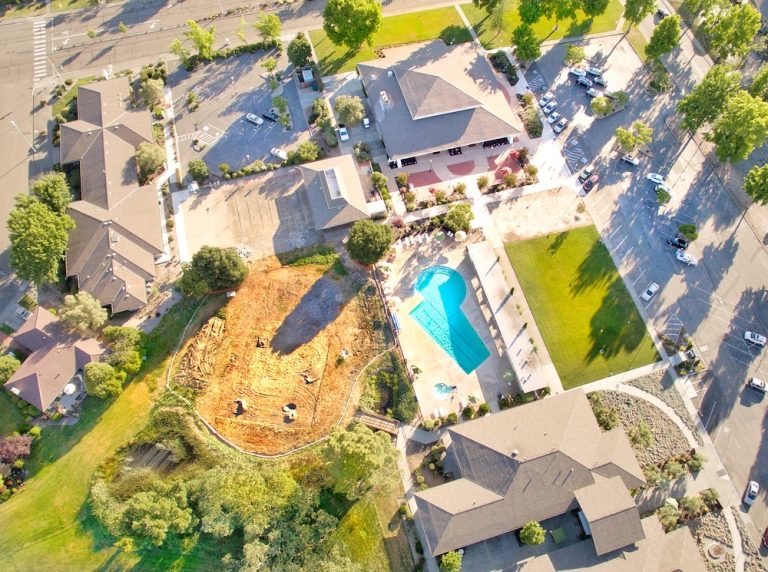
Current Site – Building Configuration and Pool

Proposed Building Improvements and Relocated Pool


Thanks for the clarifying comments on this multiyear process. Very helpful. However, we find ourselves in the middle of an expensive process in which the first question that needed an answer wasn’t asked. By default, an answer was delivered in our last board election, loud and clear.
Yet, that message has not resulted with an appropriate response to an overwhelming democratic vote. Why? Let’s collect the responses, but spend no more money before we get an answer to the basic question.
“Hope still exists”
Thank you John for such enlightening writing of the necessity of inclusiveness in any community and especially in our diverse economically community like Oakmont. This has been an uphill battle for Grassroots organization and unfornatley still is. Unless more of Oakmonters take stake in this battle to make Oakmont more democratic and affordable for everyone by amending our bylaws, it will remain a community run by a few powerful players. I am optimistic that more Oakmonters like in the last election will say to the board and some powerful individuals to listen to us, we are NOT willing to spend and spend. We can’t spend we don’t have, and are happy with improving and maintain what we have but not rebuild and get into enormous debt.
Thank you so much for this very informative article. There are two questions that I would like our General Manager, OVA Treasurer and OVA President and to answer IF they are reviewing this report and feedback:
1. How do the CAC committee members justify delaying the release of financing data until after specific choices are made? What are the potential risks and benefits of this approach?
2. Given the preliminary estimates for Concept 3 ranging from $10MM to $18MM, how are these figures expected to impact the overall financial planning for the project? Are there any specific strategies being considered to mitigate potential cost overruns or inflation impacts?
Thank you again, I learned a lot. Deb
This excellent article and appropriate comments thereto are going a long way toward defining the real issues Oakmont must face in the future. I’m beginning to appreciate the complexities involved even though my brief residence of just over two years here is my first introduction to HOA procedures, politics, problems and, hopefully, progress. Thanks for an informative introduction.
to start a new Oakmont Central Activity Center is some what fool hardy. We having rising living expenses, subject to uncontrolled fires, and expenses that the Federal and State governments assess us as citizens of this state and our local community. It is not the time to think about La La Land and blissful community. Improve what we have, expand what we need but don’t be outlandish. Think ahead, but don’t look at our children to pay the bill for our foolishness’.