
Governance, Factions, and Dialogue in Oakmont: Representing the Whole
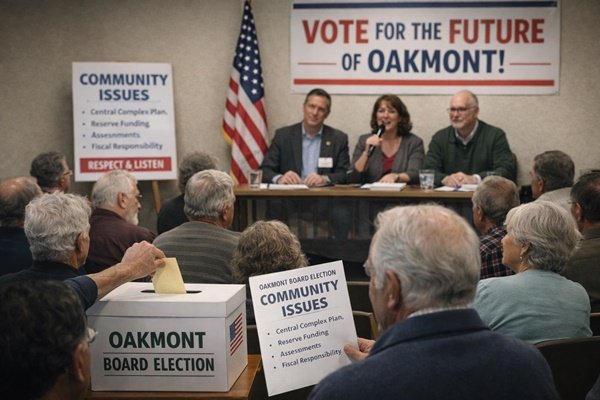
It’s almost election time in Oakmont. In any homeowner’s association, prospective board members and sitting directors carry the same fundamental obligation: represent the interests of the entire membership, not a circle of supporters, not a social network, and not a single socio-economic segment of the community.
In a 55+ active adult community like ours, that responsibility becomes even more complex.
We are not economically uniform. Some residents live very comfortably. Some come from modest Sonoma County families, others from wealthy places like Silicon Valley. Some live on fixed incomes that do not easily absorb significant increases in dues, assessments, or debt. That wealth disparity is real. When the board explores a master plan model involving tens of millions of dollars in construction costs, those differences naturally intensify.
This is how factions form.
They often begin with legitimate concerns. One group may emphasize modernization, amenities, and long-term property values that may attract wealthy retirees from out of the area. Another may prioritize affordability, reserve stability, and protection from large financial commitments. They don’t want to be priced out of their homes by escalating dues and obligations. Both perspectives can be rooted in good faith.
The trouble begins when either side assumes the other is acting out of ignorance, fear, elitism, or obstructionism.
Prospective board members should be clear about something before they file candidacy papers. They represent everyone, including those who opposed them. That means actively seeking input beyond one’s natural allies and demonstrating an understanding of how decisions affect households across the economic spectrum. Many of the most vulnerable residents may also be the quietest. They may not feel comfortable speaking up at board meetings and opening themselves up to criticism from others.
Current board members carry an even higher standard. They hold fiduciary authority. That authority requires neutrality in process, transparency in financial modeling, and respect for dissent.
Members have every right to discuss policy, planning and financial issues on social media or in the independent Oakmont Observer. That’s clearly stated in California Civil Codes. The OVA board and general manager also encourage residents to use official channels for communication like emails, open forum, town halls and the Oakmont News. It’s about balance.
For example, if you write on social media it may be helpful to also go in-person to board meetings to listen to the board and GM and then comment directly in open forum.
When major capital projects are under consideration, especially those involving borrowing or long-term financial commitments, boards must ensure that members receive clear, understandable cost information, not just conceptual designs. We recently received cost information about two central pool options from Director Matt Oliver. Our General Manager Christel Antone is working hard on obtaining three improvement options for our unique mid-century modern design Berger Center.
Governance requires informed consent. Budgets may not be easy to understand but the OVA provides time in board meetings to hear and see important financial data.
📌📌📌 Tuesday the board announced a potential purchase of the current building that houses our OVA offices.
This purchase could save money in the long and short term on rent as well as eliminate the need for building an expensive two-story building where the central pool is now.
As Director Matt Oliver states it’s an “exciting” prospect.
For members, the productive dialogue obligation is parallel. We are a community of adults with decades of life experience. Dialogue should reflect that maturity. Civil discourse does not mean agreement. It means the discussion is issue and policy based.
We have no “enemies” in Oakmont. Just neighbors that may have different financial abilities as well as different preferences for what we need in our amenities. Some have blue sky ideas while some value more modest plans. Our perceptions are based upon the very different and unique life experiences we have encountered. And the unique socio-economic status we find ourselves in today.
Tone matters, at board meetings, in committee meetings, on social media, and in casual conversations at the pool or dog park. When dialogue shifts from the SUBSTANCE of issues, trust erodes quickly.
If Oakmont is to navigate large-scale planning decisions responsibly, we must resist the temptation to reduce complex financial debates into “pro-progress” versus “anti-progress” camps. “Naysayers” vs high visibility “volunteers.” Some residents volunteer in Oakmont others in the greater Sonoma County community, some do both.
Most residents want thoughtful stewardship, fiscal prudence, and amenities that serve both current and future members. The challenge is balancing aspiration with affordability.
Healthy communities do not eliminate disagreement. They manage it constructively. They encourage dialogue across ALL communication platforms.
That is not weakness. It is governance.


Great news on possibly purchasing the property where our OVA offices are now. Makes me wonder why the OVA did not buy the property which is now Aroha Memory Care, 6575 Oakmont Drive? You mean somebody was still trying to “lead” us to spend $25-50 Million++, naturally not all at once, to construct the Walk-in-the-Park concept for which we still do not have any guestimates about costs. Now, ref. a new Berger, estimated cost about, what, conservatively speaking $20 million +, by the time you tear down the current Berger, build a new one with new: sewers, plumbing, electrical, furnishings, landscaping, sidewalks, street to get to and fro, etc. Uhh, I know I’m missing some thing! Oh, yes, maybe a story or two on top for offices and meeting rooms? So, you add another $10 million, etc. If you want something nice Oakmont can be proud of! Btw, can someone please tell me why we need a new Berger? How many events in the last 5 years, please give me a date and name of said events, necessittated people be turned away due lack of room? If that is true, why can’t the planners of such an event schedule 1 meeting in the afternoon and 1 meeting in the evening? Or, schedule evening meetings on 2 consecutive days, or have an overflow crowd use the ballroom at the East or West Rec. while also having a big screen n sound set-up so they don’t feel left-out? Ok, maybe have 2, 3, etc. big screens?
Around the time of John Taylor’s office building on the greensward a committee considered other buildings. One was a closed beauty salon near the fire station. The other was our current office.
Committee members with construction experience thought the office was poorly built and risked expensive repairs and upgrades. I doubt anyone thought we’d lease the office, spend a few hundred thousand upgrading it and pay $7500/month rent.
Yeah, I guess we should have bought it. That said, depending on price, buying it may be a good idea.
When you get people on the OVA Board who don’t care about their monthly Fees going up, and they have the mentality: well. after all, we are spending only some of our money but mostly spending other people’s money, then you also get the frame of mind: well, let’s just build something brand new, nice and shiny and glitzy, esp. since the rest of them have to pay for it! We can make it look really good by hiring architects and consultants, try to convince convince Oakmonters thru events like the 2030 Oakmont sales job and you know, we don’t have to tell them anything about costs and how much their monthly Fees will increase. Once we get their agreement and they approve everything, then we can maybe start talking a little about the costs involved!