
Democracy Requires More Than a Ballot
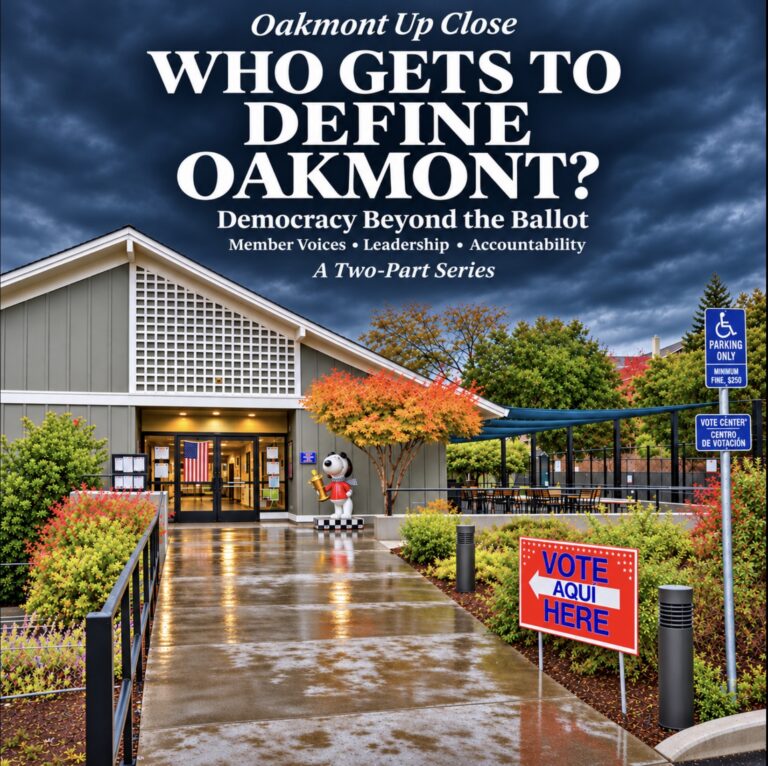
Oakmont Up Close • Part 1 of 2
An election gives leaders authority. It does not settle whose voices matter afterward. In Oakmont, directors’ decisions reach into our dues statements, reserve accounts and shared facilities long after ballots are counted. Members need meaningful influence throughout the term, when leadership’s vision carries financial consequences for the people living here now.
My interest in governance led me from nursing into political science, graduate public policy study at the Panetta Institute and work in Washington and district Congressional offices. That interest continues in Oakmont, where institutional decisions affect people’s daily lives.
This series examines democracy beyond the ballot. Part 1 explains the principles and national research. Part 2, “Who Gets to Define Oakmont,” examines President Steve Spanier’s November 13 message and tests its leadership philosophy against member participation, transparency and financial accountability.
The election is the beginning
We tend to discuss democracy as though it were a scoreboard. Our candidates win, and the system works. They lose, and suddenly we discover its shortcomings.
That is a poor standard for a country and an equally poor habit for a community. A system that protects our voice only when our preferred leaders hold office offers little protection.
The harder questions come afterward. Can people obtain information needed to challenge a decision? Must leaders explain their reasoning? Can criticism change an outcome, or is it merely tolerated until the meeting ends?
Five questions worth asking
The Varieties of Democracy project, known as V-Dem and coordinated at Sweden’s University of Gothenburg, examines five major democratic principles. The terminology sounds academic. The questions are practical.
Electoral democracy asks whether people can choose their leaders through meaningful, competitive elections, with freedom to organize and speak. A ballot matters when people have a real choice and can make it freely.
Liberal democracy asks what restrains those who win. It concerns individual rights, the rule of law and checks on executive power. “Liberal” describes constitutional protections. Conservatives have as much interest in those protections as anyone else, especially when the other party takes office.
Participatory democracy asks what people can do through direct voting and between elections. Civic organizations, local bodies and opportunities for involvement matter because a public reduced to watching its leaders has limited influence over them.
Deliberative democracy asks how decisions are reached. Do leaders offer reasons, examine evidence and consider opposing arguments? Consultation matters when a well-supported objection can still change a proposal. Treating public opinion as an obstacle rather than evidence weakens that process, even when people remain free to speak.
Egalitarian democracy asks whose voice carries weight. A right everyone possesses on paper may be much easier for the wealthy, well-connected or well-positioned to exercise.
Together, these principles explain how a country can hold elections while its democracy weakens. They also offer questions for any institution claiming to represent people.
America does not get a lifetime exemption
Many of us grew up assuming American democracy was secure. We could argue about policy while taking the system’s survival for granted. Recent research challenges that confidence.
The deterioration did not begin with Trump’s return to office in 2025. V-Dem’s earlier research found that reasoned policy arguments and respect for opposing arguments deteriorated around the 2016 election and during his first administration. Its October 2024 analysis, using data through 2023, found those measures had not recovered. Public participation in independent policy debate also declined during 2016–2020.
Democracy depends on more than allowing an argument. Leaders must be willing to answer it. When evidence loses ground to personal loyalty and opponents become enemies, the public loses a way to test whether policy makes sense.
The second term brought sharper deterioration. V-Dem’s 2026 report, covering 2025, puts the U.S. Liberal Democracy Index at 0.57, down from 0.75 in 2024—a 24 percent decline in one year. Its ranking fell from 20th to 51st among 179 countries. These are research index scores, not percentages of Americans retaining their rights.
The report identifies weakened congressional checks on the president as the hardest-hit component. Its legislative constraints measure lost roughly one-third of its value in 2025, reaching its lowest level in more than a century. It also documents deterioration in equality before the law, civil liberties and freedom of expression, alongside pressure on the judiciary and independent media.
Election-specific indicators were not reassessed in 2025, a year without a national election. The warning concerned safeguards surrounding elected power: whether Congress restrains it, courts can challenge it and the press can investigate it. Keeping an election calendar does not guarantee accountability.
Winning an election does not settle these concerns. The conduct of the winners is precisely what must be examined. The same protections should matter regardless of which party benefits. Otherwise, our defense of democracy becomes a defense of our own side, leaving everyone vulnerable when power changes hands.
Freedom House uses a different framework. Its 2026 report still classifies the United States as “Free,” while lowering its score from 84 to 81 out of 100. Both findings matter: substantial freedoms remain, and those freedoms can deteriorate.
These reports assess 2025. They cannot tell us what the 2026 midterm election will change. But there is hope in people’s determination to exercise their voice.
Making the right to vote meaningful
On November 11, CNN projected Scott Colom had won Mississippi’s Senate race, making him the state’s first Black U.S. senator elected since Reconstruction. Behind that historic projection is a story about people fighting to make their ballots count.
CNN reported that thousands of Mississippians cast provisional ballots because their names were missing from precinct poll books or they lacked required identification. Voter-roll maintenance had left many registrations marked inactive.
Mississippi used Experian’s commercial address data to flag voters who might have moved, although those addresses were not verified residences. Some eligible voters were mistakenly marked inactive, creating hurdles to voting and risking eventual removal. Election officials made those decisions; Experian supplied the data.
Some voters described being sent between precincts or visiting a courthouse to resolve problems. Volunteers helped people check ballots and provide documentation. Some succeeded; others learned their votes would not count.
A right on paper becomes meaningful when people can exercise it. These voters and volunteers offer reason to resist despair: participation can survive formidable obstacles when citizens organize and insist on being counted.
Oakmont’s circumstances are very different. The broader lesson still matters. Participation takes effort, and institutions have a responsibility to make it meaningful. We should value neighbors who keep asking questions and showing up.
The connections that sustain participation
Since 1972, NORC’s General Social Survey has tracked American attitudes and behavior. Questions about trust, confidence in institutions and voluntary organizations help researchers examine civic life over time. These measure people’s experiences and beliefs, rather than rate democratic safeguards.
Political scientist Robert Putnam drew on this broader research tradition in Bowling Alone. He documented declining involvement in many forms of organized community life and argued that social connections sustain cooperation. He calls these networks, and their associated trust and reciprocity, “social capital.” His argument gives us another reason to care when people stop joining, volunteering or participating.
Oakmont has an opportunity here. Clubs, recreation programs and volunteer groups bring neighbors together repeatedly. Those relationships can help people exchange information, work through disagreements and organize around shared concerns. That is my application of the research, rather than a finding about OVA.
Friendliness alone does not establish accountability. Civic engagement includes asking difficult questions, organizing around affordability and challenging priorities. Participation should not be valued only when it supports leadership. Neighbors who disagree can contribute information and perspectives that a comfortable consensus overlooks. That is how Putnam’s research informs my questions about Oakmont.
Read the evidence and question it
Researchers do not possess an indisputable democracy thermometer. Assessing judicial independence or freedom to criticize government requires judgment. V-Dem uses expert assessments and statistical methods to estimate conditions, including uncertainty.
Its findings deserve scrutiny. Definitions and methods matter. A ranking requires more thought than a dramatic headline. But dismissing uncomfortable findings because they reflect badly on a favored leader is no substitute for examining them.
Ask which protections weakened, what evidence supports that conclusion and what would demonstrate improvement. The same discipline belongs in local commentary. Criticism should identify a decision, process or documented problem. Leaders deserve a fair opportunity to respond, and readers should be able to check sources.
Being heard should mean something
For Oakmont, the most useful distinction may be between permission to speak and an opportunity to influence a decision.
Imagine a costly proposal presented after the preferred design has been developed and alternatives largely set aside. Residents may comment. But what can those comments still change?
Or consider a financial presentation delivered orally at a meeting, without advance explanatory materials. Members can listen, but they have little opportunity to study assumptions or prepare questions. Tables help; understandable written explanations and time to examine them make access useful.
These illustrate participation’s limits, not V-Dem findings. Nor does participation require every decision to go to a community vote. We elect representatives to exercise judgment. That judgment should remain open to evidence, scrutiny and the people affected.
That is especially important in a retirement community, where residents bring different incomes, abilities and levels of comfort with financial documents. An invitation to participate is stronger when information is understandable and people have a realistic opportunity to respond. Leaders learn more when they hear from residents beyond the familiar voices at meetings.
Members questioning a project also help pay for it. Asking about costs, alternatives and financial capacity is a reasonable part of belonging. A community’s future and its current residents’ interests must be considered together.
Next who gets to define Oakmont
Part 2 begins with Spanier’s November 13 President’s Message, “Elections Have Consequences.” He distinguishes Oakmont from “the individuals who currently live here.” What does that distinction mean for members whose priorities differ from the board’s? His words make the question of accountability between elections immediate and concrete.
An HOA is not a nation, and V-Dem has not rated Oakmont. These principles offer questions, not a scientific score or a claim that the institutions have equivalent powers. Directors must exercise judgment and sometimes make unpopular decisions. The test is whether that judgment remains open to evidence, challenge and correction.
Part 2 examines written-report gaps, a Central Pool presentation omitted from the minutes supplied to members, and the need for a combined financial capacity plan covering Berger, golf obligations and other facilities. These examples test whether members can influence decisions while alternatives remain open, rather than merely hear about them afterward.
Elections have consequences. So does the way elected leaders treat questions, criticism and the people financing their decisions. Representation requires accountability throughout the term.
Sources
Panetta Institute for Public Policy mission and programs under Secretary Leon Panetta and Sylvia Panetta
https://www.panettainstitute.org/about-us/
Secretary Leon Panetta Institute cofounder and chairman and his public service career
https://www.panettainstitute.org/about-us/institute-people/leon-panetta/
V-Dem Democracy Report 2026 including global findings and the United States analysis
https://v-dem.net/documents/75/V-Dem_Institute_Democracy_Report_2026_lowres.pdf
V-Dem methodology and uncertainty
https://www.v-dem.net/about/v-dem-project/methodology/
V-Dem Codebook v16 definitions of the five democracy indices
https://v-dem.net/documents/70/codebook_v16.pdf
V-Dem explanation of liberal democracy
https://v-dem.net/news/varieties-of-democracy-liberal-democracy/
V-Dem March 2026 release on American decline and election indicators
https://www.v-dem.net/news/press-release-democratic-backsliding-reaches-western-democracies-with-us-decline-unprecedented/
Our World in Data egalitarian democracy chart and averaging methods
https://ourworldindata.org/grapher/egalitarian-democracy-index-vdem
Our World in Data historical democracy overview
https://ourworldindata.org/democracy
Freedom House United States 2026 assessment
https://freedomhouse.org/country/united-states/freedom-world/2026
V-Dem analysis of changes since the 2016 election published October 2024
https://www.v-dem.net/news/the-us-elections-and-democracy-polarization-and-the-quality-of-debate/
CNN reporting on Mississippi voter rolls and provisional ballots November 11, 2026
https://www.cnn.com/2026/11/11/politics/live-news/hegseth-impeachment-congress
NORC General Social Survey data and documentation
https://gss.norc.org/
Robert D Putnam Bowling Alone research and overview
https://robertdputnam.com/bowling-alone/
Robert D Putnam Bowling Alone Americas Declining Social Capital Journal of Democracy 1995
https://www.journalofdemocracy.org/articles/bowling-alone-americas-declining-social-capital/
Steve Spanier November 13 2026 President’s Message Elections Have Consequences
https://oakmontvillage.com/article/presidents-message-elections-have-consequences/

